CrossFit Athletes: 23 lb, 36 lb, or 45 lb? Picking Your Competition Weight
With Memorial Day right around the corner, tens of thousands of athletes around the world are gearing up to take on one of the ultimate fitness tests: The Murph Hero WOD. This brutal workout is designed to honor Navy Lieutenant Michael Murphy, who was tragically killed in action in Afghanistan in 2005.
If you’ve ever done it, you know it’s a physical and psychological battle. If you haven't... brace yourself. To ensure your Memorial Day workout is memorable for your performance—and not a medical emergency caused by terrible gear choices—here is your definitive guide to picking the right weight vest and understanding the strength metrics needed to compete.
Is a Weighted Vest Great for CrossFit?
Yes, a weighted vest is a staple of CrossFit training. It is the signature element of iconic benchmark workouts like "Murph" and is regularly featured at the CrossFit Games to test an athlete's elite work capacity.
While walking dominates daily use, a dedicated 6% to 8% of users specifically deploy their weight vests for high-intensity CrossFit training and the Murph challenge.
|
Exercise Category |
User Participation Rate / Frequency Metrics |
|
Walking / Dog Walking |
77% – 93% (Top 2 for Highest Frequency) |
|
Household Chores |
80% – 90% |
|
Running |
65% – 67% |
|
Strength Training |
63% – 65% |
|
Cardio Training |
56% – 60% |
|
Hiking / Rucking |
33% – 38% |
|
Yoga / Pilates |
29% – 31% |
|
CrossFit |
6% – 8% |
According to a survey of 1,069 verified US weighted vest purchasers conducted between January 15 and February 1, 2026 by Zelus:
Participants: 61% Female, 39% Male | US Only | Average Age: 43
Methodology: Verified post-purchase digital questionnaires tracking athletic usage habits, gear failure points, and user biomechanical feedback.
While it is perfect for overloading strict bodyweight gymnastics (pull-ups, push-ups, squats) and boosting cardiorespiratory demand during runs or engine intervals, it can become a joint liability during high-velocity kipping movements or high-impact bounding if your core stability isn't fully established.
Because CrossFit involves extreme physical transitions, the key to safety and performance is bypassing loose, bulky options and selecting a slim-profile plate carrier that ensures a secure, zero-bounce fit.
How to Choose Your Perfect Weighted Vest for CrossFit?
Out of the comprehensive quantitative survey of 1,069 verified US purchasers conducted by Zelus, a sample of dissatisfied users (n=36) highlighted the primary flaws in current market designs: An overwhelming 67% to 75% of dissatisfied users cited uncomfortable wearability and inconvenient donning/doffing (difficulty putting the vest on or taking it off) as the core reason for their frustration.
When you are dropping into hundreds of repetitions, that 6% to 8% represents the absolute highest demand placed on a vest's structural integrity. Any minor stability defect will be amplified a thousandfold when jumping onto a pull-up bar, dropping into handstand push-ups, or running miles. Choosing the right vest requires balancing extreme capacity with a secure, zero-bounce fit.
The Golden Rules of Weight Vest Selection
Before diving into specific loads, let’s establish a baseline. Vests generally fall into two categories: plate carriers (slim-profile vests that hold solid steel plates) and adjustable pocket vests (which use sandbags or iron ingots).
Beginner Tip: If you are new to weighted training, ignore the heavy standards entirely. A safe starting point is choosing a vest loaded to 5% to 10% of your total body weight. This allows your connective tissues and spine to adapt to downward compressive forces without destroying your mechanics.
A Simple Guide to Buying Your First Weighted Vest
Breaking Down the Weights: From RX to Extreme Strength
The load you choose dictates the type of stimulus your body receives. Here is how the most common weight vest increments function in training:
The 20 lb (Men) / 14 lb (Women) Standard (The "RX" Sweet Spot)
This is the official gold standard popularized by CrossFit and The Murph Challenge. It is intentionally engineered to balance metabolic conditioning with resistance.
- The Stimulus: Designed for high-volume bodyweight gymnastics (pull-ups, push-ups, air squats) and mid-distance running.
- The Benchmark: As a general rule of thumb, you should only attempt an RX weighted Murph if you can complete the entire workout completely unweighted in under 41 minutes with flawless form.
- Best Vest Style: Slim-profile plate carriers are ideal here because they hug the torso tightly, preventing the vest from bouncing and hitting your chin during runs or double-unders.
The 23 lb Weight (The Tactical Bridge)
Commonly utilized in professional performance kits and elite military prep, this weight is slightly heavier than the standard RX load.
- The Stimulus: It serves as a bridge between classic functional conditioning and heavy tactical operations.
- The Application: Use this weight if the 20 lb vest no longer challenges your cardiovascular system, but you still want to maintain fluid running mechanics without shifting into a slow rucking stride.
The 36 lb Weight (Advanced Strength Capacity)
A massive jump from the RX standard, a 36 lb vest completely alters your center of gravity and places extreme loading on your spine and shoulders.
- The Stimulus: This weight shifts the workout from a cardiorespiratory focus to a pure muscular endurance and strength test.
- The Application: Best reserved for shorter sprint-carries, heavy box step-ups, or rucking. High-volume gymnastics movements—especially dynamic ones like kipping pull-ups or toes-to-bar—should be strictly avoided at this weight to prevent severe joint strain.
The 45 lb Weight (Extreme Strength & Tactical Conditioning)
This is the heavy artillery of vest training. A 45 lb vest is designed almost exclusively for powerlifters, advanced rucking, or elite tactical personnel preparing for real-world deployment loads.
- The Stimulus: Pure structural capacity and core stabilization.
- The Application: At this weight, traditional high-intensity CrossFit metcons are off the table. Dynamic bodyweight movements like burpees or bounding box jumps can easily overload your spine and knees upon impact. Instead, use this load for strict pull-ups, push-ups, heavy lunges, and structural rucking.
Your Current Bodyweight (The 10% Baseline Rule)
Your mass dictates how much extra downward force your connective tissues can safely handle.
- Under 150 lbs (68 kg): Jumping straight to a standard 20 lb RX vest means adding over 13% of your body weight in one go. If you fall into this category, you need a highly adjustable pocket vest or thin, modular plates so you can incrementally build up from 10 lbs.
- 150 lbs to 200 lbs (68–91 kg): You fall into the standard zone where a 14 lb or 20 lb vest aligns beautifully with human biomechanics for dynamic movement.
- Over 200 lbs (91 kg+): Your joints are already carrying significant mass. When adding a vest, ensuring an ultra-tight, contoured fit is paramount to prevent the vest from gaining momentum during high-impact movements like box jumps or running.
Read More: What Size Weighted Vest Should I Get
Your Unweighted Murph Time
Your fastest unweighted Murph time is the ultimate indicator of your work capacity and gymnastics efficiency.
- Sub-40 Minutes: Your capacity is exceptional. Your tendons, cardiovascular system, and muscular endurance are fully prepared to handle the standard 20 lb (men) vest / 14 lb (women) RX vest without breaking form.
- 41 to 50 Minutes: You have a solid aerobic base, but strapping on a full RX vest right now will likely cause your movement to grind to a halt during the push-ups and pull-ups. Your ideal setup is a scalable vest loaded to about 10–12 lbs (for men) or 6–8 lbs (for women) to bridge the gap.
- 50+ Minutes or Scaled: If you are still working on mastering unweighted high-volume gymnastics, a weight vest will only compromise your mechanics. Your ideal setup is no vest yet. Master the mechanics unweighted first!
Your Primary Goal
What are you actually trying to achieve when you put the vest on?
|
Goal |
Ideal Setup |
Best Movement Types |
|
A: RX CrossFit Competition |
Low-profile plate carrier with curved steel plates (14 lbs F / 20 lbs M). Ultra-tight fit. |
Kipping gymnastics, 400m sprints, double-unders. |
|
B: Aerobic Endurance & Longevity |
Adjustable pocket vest filled with sandbags or flexible ingots (5% to 8% of body weight). |
Zone 2/3 steady-state runs, rucks, functional triplets. |
|
C: Raw Strength & Tactical Capacity |
Heavy-duty, reinforced vest scaled to 36 or 45 lbs with thick, padded shoulder straps. |
Strict pull-ups, heavy dips, box step-ups, heavy rucking. |
Best Weighted Vest for CrossFit Athletes

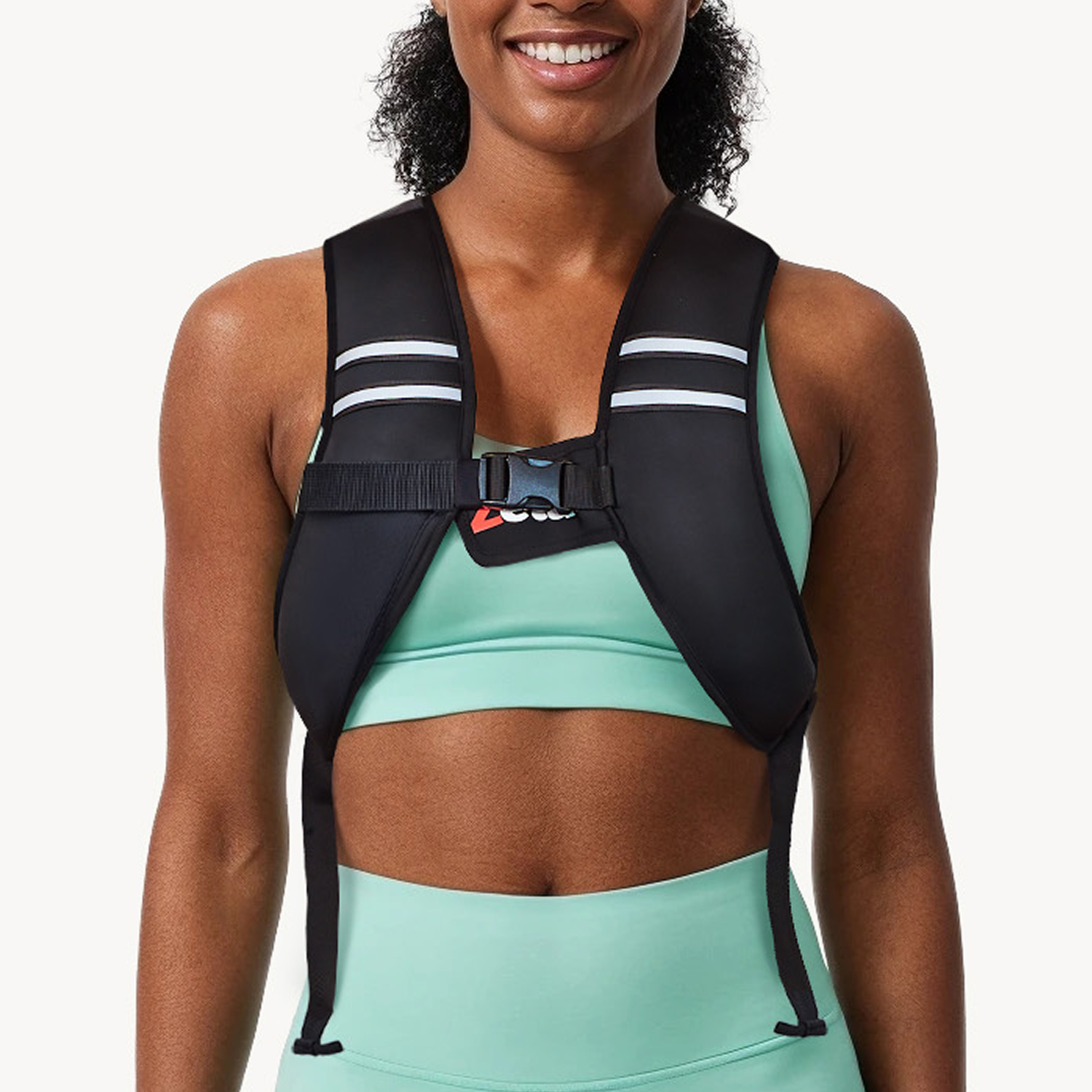
If you are looking for a rugged, mission-grade plate carrier designed to handle heavy-duty training, the Zelus FWV-HT is built exactly for that purpose. Engineered for high-intensity disciplines like CrossFit, Rucking, and pure strength training, this vest is tailored for athletes who want to push their absolute limits.
|
PRODUCT |
|
|
IMAGE |
 |
|
TECHNOLOGY |
Heavy Training |
|
IMAGE |
Performance |
|
RECOMMENDED SPORTS |
CrossFit · Rucking · Strength |
|
WORKOUT INTENSITY |
💪💪💪💪💪 |
|
COMFORT |
★★★☆☆ |
|
SHAPE |
Y-Shape |
|
WEIGHT TYPE |
Adjustable |
|
WEIGHT RANGE |
23 / 36 / 45 lb |
|
FILL MATERIAL |
Solid Iron Block |
|
BUILD MATERIAL |
900D Oxford Fabric + Foam |
|
NOISE LEVEL |
Low |
|
COLORS |
1 (Black) |
|
REFLECTIVE STRIPS |
Yes |
|
Cleaning Choice |
Machine wash |
|
POCKETS / STORAGE |
No |
10 Best Weight Vest CrossFit Workouts
Strapping on extra weight fundamentally changes the stimulus of a workout, demanding more from your lungs, your legs, and your mind. Here are the 10 best CrossFit benchmark and hero workouts to tackle with a vest.
The Benchmarks: From Classic Hero Wods to Brutal Triplets
|
# |
Workout Name |
The Blueprint / Workout Structure |
Target Equipment & Loading |
Pro Strategy & Scaling |
|
1 |
Murph |
For Time: • 1-Mile Run • 100 Pull-Ups • 200 Push-Ups • 300 Air Squats • 1-Mile Run |
Pull-up rig, open running space. (Traditional RX Vest: 20 lbs M / 14 lbs W) |
Can be done "vanilla" style (straight through) or partitioned. A classic approach is breaking the middle section into 20 rounds of 5 pull-ups, 10 push-ups, and 15 air squats between the two miles. |
|
2 |
Master Splinter |
3 Rounds for Time: • 400m Run • 12 Burpee Box Jump Overs • 15 Thrusters |
Plyo box, barbell. • Men: 43 kg (95 lbs) • Women: 30 kg (65 lbs) |
A short, sharp 12- to 15-minute engine test. Use the 400m run to recover your breathing, maintain smooth pacing on the burpees, and fight to stay unbroken on the thrusters. |
|
3 |
Sisson |
20-Minute AMRAP: • 1 Rope Climb (15 ft) • 5 Burpees • 200m Run |
15-foot climbing rope, open running space. |
Tests upper-body pulling power and aerobic capacity. Modification: No rope? Easily substitute the single rope climb for 5 strict pull-ups. Pace yourself early—it gets spicy fast. |
|
4 |
Will Lindsay |
10 Rounds for Time: • 3 Devils Press • 22 Alternating Lunges • 19 Air Squats |
Pair of heavy dumbbells. • Men: 25 kg (55 lbs) • Women: 15 kg (35 lbs) |
An absolute onslaught on the legs and posterior chain. Any set of dumbbells will do as long as they challenge you. Just prepare to say goodnight to your quads and glutes. |
|
5 |
J |
20-Minute AMRAP: • 22 Air Squats • 12 Toes-to-Bar • 9 Burpees |
Pull-up bar. |
A minimalist, classic CrossFit triplet. Designed with low localized fatigue in mind so you can transition seamlessly from one movement directly into the next without stopping. |
Advanced Grunt Work: Heavy Bars and Complex Gymnastics
|
# |
Workout Name |
The Blueprint / Workout Structure |
Target Equipment & Loading |
Pro Strategy & Scaling |
|
6 |
Bubba |
20-Minute AMRAP: • 6 Dumbbell Man Makers • 7 Dumbbell Box Step-Ups |
Plyo box, pair of dumbbells. • Men: 25 kg • Women: 15 kg |
A soul-crushing couplet. Note on Man Makers: A single rep is a push-up, left-arm row, right-arm row, and a squat clean thruster. Six of these "spicy boys" in a vest will test your absolute resolve. |
|
7 |
David Fairbrother |
10 Rounds for Time: • 3 Handstand Push-Ups • 8 Chest-to-Bar Pull-Ups • 2 Deadlifts |
Barbell, gymnastics rig, wall space. • Men: 150 kg (330 lbs) • Women: 100 kg (220 lbs) |
Brings out the big guns with high-skill gymnastics and a heavy barbell. The Scale: If the deadlift weight is dangerously heavy, scale the load to roughly 65% of your 1RM. |
|
8 |
Dixon |
7 Rounds for Time: • 7 Deadlifts • 19 Push-Ups • 7 Power Cleans • 19 Pull-Ups |
Barbell, pull-up rig. • Men: 61 kg (135 lbs) • Women: 43 kg (95 lbs) |
Combines gymnastics with high-volume variance pulling. Pro Tip: Power cleaning with a thick weight vest can feel incredibly awkward. Practice cycling a few reps with an empty barbell before you start. |
|
9 |
Airborne |
20-Minute AMRAP: • 400m Run • 5 Ring Muscle-Ups |
High rings, open running space. |
Truly lives up to its name. The Scale: If you don't have access to rings or haven't mastered the movement yet, feel free to substitute with bar muscle-ups or standard pull-ups. |
|
10 |
Luce |
3 Rounds for Time: • 1,000m Run • 10 Ring or Bar Muscle-Ups • 100 Air Squats |
Gymnastics rig or rings, open running space. |
A long-form engine and structural capacity test. Requires deep mental toughness. The Scale: If needed, substitute the muscle-ups with standard pull-ups to keep moving. |
7 Best Weighted Vest Exercises
How Strong Do You Need to Be to Compete in CrossFit?
If you watch the CrossFit Games, you see athletes moving jaw-dropping weights while sprinting like track stars. It’s easy to assume you need world-class powerlifting strength just to step onto a local competition floor.
However, real coaching data and elite-level testing reveal a more nuanced truth: Strength absolutely matters, but it is only one piece of a highly complex performance puzzle.
"Strong Enough" vs. "As Strong As Possible"
CrossFit is not a pure strength sport. Unlike powerlifting or Olympic weightlifting, where maximal load is the sole metric of success, CrossFit demands a blend of maximal strength, strength endurance, gymnastics capacity, and metabolic efficiency under extreme fatigue.
Because of this, the real question is: Are you strong enough to express your fitness in competition? Beyond a specific threshold, chasing increases in your 1RM produces diminishing returns. If a massive deadlift comes at the expense of your aerobic engine, it becomes a liability rather than an asset.
The Strength Benchmarks
At the highest level of the sport (Games and Semifinals), numbers have hit a natural human balance point for multi-sport fitness. For serious intermediate athletes (Quarterfinals or local competitions), the targets are accessible but highly defined.
|
Movement |
Intermediate Men's Targets |
Intermediate Women's Targets |
Elite Male Peak Ranges |
Elite Female Peak Ranges |
|
Back Squat |
~400 lb |
~300–350 lb |
~500 lb |
~330–380 lb |
|
Deadlift |
~450–475 lb |
~255 lb |
~550–600+ lb |
~380–415 lb |
|
Snatch |
~185 lb (Min) |
~125 lb (Min) |
~315 lb |
~200–205 lb |
|
Clean & Jerk |
~250 lb |
~175 lb |
~395 lb |
~260–270 lb |
The Elite Takeaway: The limiting factor at the top level is rarely raw strength. It is the athlete's ability to apply 80% of that max strength repeatedly while their heart rate is redlined at 180 beats per minute.
Key Performance Limiters
Why Olympic Lifts Trump Power Lifts
Movements derived from Olympic weightlifting—the snatch and clean & jerk—are far more predictive of competitive CrossFit success than slow, maximal powerlifting lifts like the bench press.
CrossFit heavily tests barbell efficiency and explosive power under fatigue. In a competition setting, an athlete with a technically flawless 225 lb clean & jerk will almost always beat an athlete with an ugly, muscled-out 250 lb lift because the former wastes far less energy per repetition.
The Real Bottleneck: Strength Endurance
A major trap intermediate athletes fall into is assuming a higher 1RM fixes everything. They believe going from a 315 lb to a 375 lb back squat will automatically make them faster in a workout.
In reality, max strength builds capacity, but strength endurance wins workouts. To break through, elite training programs shift away from heavy singles and focus heavily on:
- High-power barbell cycling intervals.
- Repeated submaximal lifting under tight time constraints.
- Mixed-modal conditioning (e.g., heavy cleans mixed directly with rowing and burpees).
Where Should You Focus Right Now?
Your training focus should change dynamically based on where your numbers currently sit:
- Early / Developing Athletes: Focus heavily on building a baseline of general strength, gaining lean muscle mass, and mastering basic movement mechanics unweighted.
- Intermediate Athletes: Work aggressively to hit the minimum strength thresholds noted above while introducing barbell cycling and stamina work.
- Advanced / Elite Athletes: Maintain your current strength ceilings while prioritizing sport-specific conditioning, fatigue-based performance, and refining movement weak links.
You need to be strong enough that strength is not the reason you lose. Reaching intermediate benchmarks unlocks total access to competitive functional fitness. But past those points, the crown will always go to the athlete with the best endurance, the sharpest skills, and the highest movement efficiency. Strength is essential—but it is never the whole story.
The Finish Line: Gear Up with Intention
Whether you are stepping onto the tarmac for a weighted Murph this Memorial Day or pushing for a new spot on the local leaderboard, remember that your gear dictates your performance ceiling. A weighted vest is a phenomenal training tool, but it is entirely unforgiving to bad form and mismatched weights.
Be honest with your current strength, respect your body’s biomechanics, and choose the load that matches your true operational goals. At the end of the day, CrossFit isn’t won by the athlete who puts on the heaviest vest just to suffer through broken mechanics; it’s won by the one who moves with flawless efficiency, relentless consistency, and a razor-sharp engine.
Pick your weight, strap it down tight, and go shatter your next PR safely.
Before You Go…
Here are a few handpicked articles to inspire your next self-care moment.