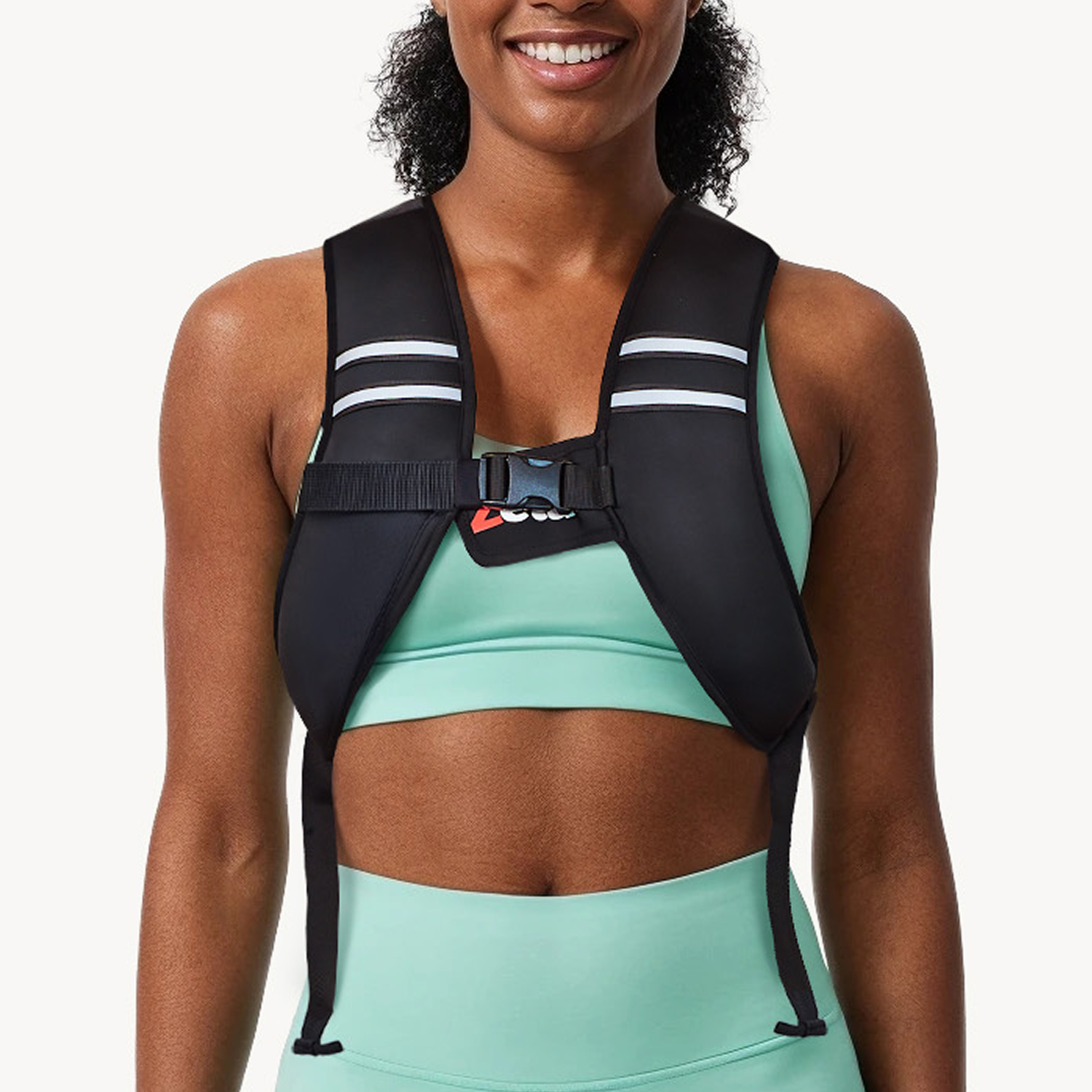
Zelus weighted vests
Find your weighted vest size
Two numbers. We'll pick the vest.
Your chest measurement and your bodyweight are all we need. Tell us those and we'll point you at the vest that closes properly on your frame and carries a load your body is ready for.
Find your fit
Measure your chest over a t-shirt, at the fullest point, arms down. If you wear a bra, use your bust measurement — not your band size.
This sets your starting load, not your size. Adding weight later is easy — swapping a vest isn't.
Pick a series or a specific vest and we'll work within it. If it won't close on you, we'll say so and show you the one in that series that will.
Rather ask a person?
We'll size you up ourselves
Torn between two sizes? Big bust, a bad knee, or a vest two people will share? Send us your measurements and our fit team will come back with one specific answer.
Or email support@zelusfitness.com — most replies land the same day.
Step 01
How to measure your chest
A vest that's an inch off doesn't fit slightly worse — it doesn't buckle at all. Ninety seconds with a soft tape now, and the right vest arrives first time. No wrong size to send back, no waiting on a replacement, no gap in your training.
Where to measure
Around the fullest part of your chest, tape level front to back, straight under the armpits.
How to hold the tape
Over a t-shirt — not bare skin, not over a hoodie. Arms down, breathe out normally. Don't puff up and don't suck in.
If you wear a bra
Use your bust measurement, not your band size. A 34G band is 34" but the bust is around 47", and the vest closes around the bust.
Step 02
Weighted vest chest ranges at a glance
The red line is the chest measurement you entered. Each coloured bar is one vest's chest range — where the red line crosses a bar, that vest closes on you. Where it falls on empty grey, that vest's range doesn't reach your measurement.
Reading the chart
Step 03
How much weight should you start with?
The usual advice is a share of your bodyweight. Here's what that works out to in vests we actually stock — start at the low end and give it two to three weeks before you add anything.
Guidance by activity
| Activity | Start at | Work up to | What it feels like |
|---|---|---|---|
| Walking & hiking | 5% | 10% | Noticeable on hills and stairs, easy to wear for an hour. |
| Running | 5% | 10% | Start light — impact multiplies load. Fit matters more here than anywhere. |
| Bodyweight strength | 10% | 15% | Push-ups, pull-ups, squats. You'll feel it by the third set. |
| Rucking & advanced | 15% | 20% | For people already training loaded. 20% is a ceiling, not a target. |
Starting weight by bodyweight
| Bodyweight | New to this | Trains regularly | Why this figure |
|---|
Every figure here is a weight we actually sell, so you can order it as it reads. Wear a light load for 30–60 minutes at a time; once you're past 5% of your bodyweight, keep sessions to 15–30 minutes and take rest days.
Step 04
Full weighted vest size chart
Chest ranges are measured on the finished garment and carry a ±5% tolerance.
Step 05
How to clean your weighted vest
Vests absorb sweat. How you clean one depends on how the weight is built in — check yours before you put it anywhere near a machine.
Machine washable
Take every weight out first, then wash as normal. Store flat or hung.
Applies to
- Z-Fit™ Slim Flex
- Z-Fit™ Slim Flex Adjustable
- Classic Y-Shaped Adjustable Weight
- Performance Y-Shaped Adjustable Weight
- Performance Y-Shaped 23 lb and 45 lb
Wipe clean, occasional soak
Damp cloth or disinfectant spray after training. Every so often, soak-wash by hand. Don't machine wash and don't iron.
Applies to
- Z-Fit™ Slim
- Z-Fit™ Slim Adjustable
Wipe clean only
The iron sand is sealed into the shell, so these don't go in water. Damp cloth or disinfectant spray. Don't iron.
Applies to
- Classic X-Shaped Fixed Weight
- Classic Y-Shaped Adjustable Weight
- Classic U-Shaped Fixed Weight
- Classic U-Shaped Adjustable Weight
Step 06
Weighted vest sizing questions
I'm 5'0" and 85 lb — how many pounds should I wear?
Around 4–5 lb for walking, which is roughly 5% of your bodyweight. Fit is the thing to check first: at that height your chest is likely in the low 30s, and the Z-Fit™ Slim Flex Adjustable closes from 28.7" — the smallest we make — and adjusts from 1.1 lb upward. If you'd rather keep it simple, the fixed Z-Fit™ Slim 5 lb fits from 32.2".
My chest is 47" (34G) — which weighted vest will actually buckle?
Plenty of them. At 47" you're inside the range for the Z-Fit™ Slim Adjustable 11–20 lb (33.8–49.6"), the Slim Flex Adjustable (up to 52"), and several Classic and Performance vests. One check before you order: use your bust measurement, not your band. A 34G band is 34" but the bust is around 47", and the vest closes around the bust.
I'm 6'4" and 250 lb — will anything fit me?
Yes. Measure your chest, because that decides it. Up to 49.6" the Z-Fit™ Slim Adjustable 11–20 lb works; up to 52" the Slim Flex Adjustable; up to 55.9" the Slim Adjustable 20–32 lb; up to 57.4" the Classic U-Shaped Adjustable. Beyond that, message us — we'll sort it out with you directly rather than guessing from a chart.
I'm 63 and 160 lb — should I start at 6 lb or 8 lb?
8 lb. At 160 lb, 5% is 8 lb, and that's the standard starting point for walking regardless of age. That points at the Z-Fit™ Slim Adjustable 8–14 lb, which starts at exactly 8 lb and adjusts up to 14 lb as you progress. If you'd rather start lighter, the fixed Z-Fit™ Slim 5 lb works too. Either way, walk with it for two to three weeks before adding weight.
I'm between two sizes — should I size up?
Not on a fixed-weight vest, where each weight is a different shell — sizing up there means carrying more weight, not just wearing a roomier vest. Take an adjustable one instead, or the Z-Fit™ Slim Flex, which comes in M and L at both weights.
Can two people share one weighted vest?
Yes, if you pick an adjustable one and both chest measurements sit inside its range. Check both before you order — the finder takes one measurement at a time, so run it twice and look for a vest that appears in both answers.
Chest ranges are measured on the finished garment and carry a ±5% tolerance. Loading guidance is general information, not medical advice.
Shop by Series